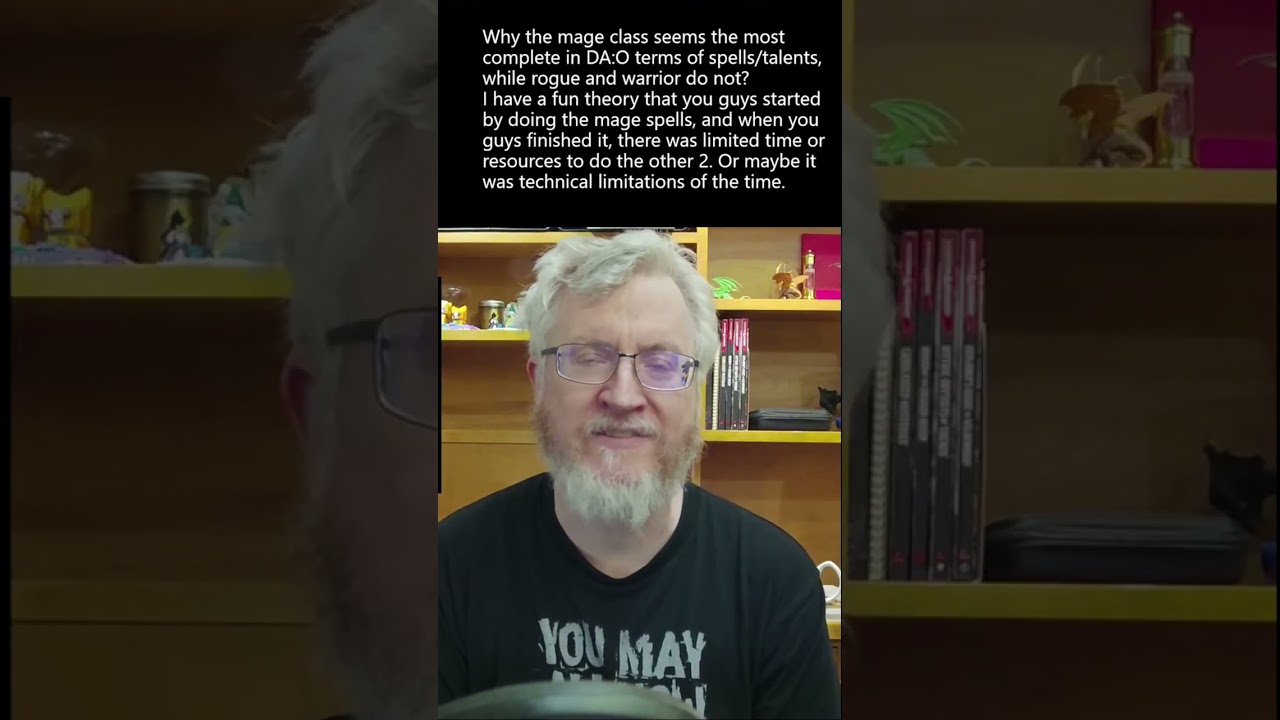
In response to a viewer question in a 200k subscriber Q&A for his , former BioWare producer Mark Darrah explained why Mages in Dragon Age: Origins were so .
"I would say it's more because the design space that Dragon Age: Origins was being built into was heavily influenced by second edition D&D," said Darrah. Advanced Dungeons & Dragons, or AD&D, formed the basis of the mini RPG golden age of Infinity Engine games started by Baldur's Gate.
Fighters and related combat classes in the OG Baldur's Gates are mostly there to auto attack enemies, the Battlemaster maneuvers and whirlwind attacks of later games just a twinkle in some designer's eye.
Mages, meanwhile, could summon demons, draw on a host of direct damage and crowd control effects, and even engage with an interactive Wish spell with ironic punishments for poorly worded wishes due to a low Wisdom score. You can see Baldur's Gate 2's Throne of Bhaal expansion try to ameliorate this with the addition of "High Level Abilities"—basically feats by another name.
I've always been partial to Rogues in Origins, but you can see who got the most love of the trio: Warriors and Rogues share archery and dual weapon ability trees, with some special dirty H25 tricks and the requisite sneak attacks for Rogues, while Warriors get exclusive access to two-handers and the sword and board setup. Just like in Baldur's Gate, Mages have a smorgasbord of game-changing spell effects.
But there's one more factor Darrah points to as well: Origins' relative realism compared to h25 com สล็อต later entries in the series. "Of all the Dragon Ages, Dragon Age: Origins is the most 'grounded,'" said Darrah. "It's the one that's worrying the most about everything making perfect sense within the overall lore of the game."
"So Warriors and Rogues in Origins basically don't have talents or skills that violate physics, whereas, as we move into Dragon Age 2 and Inquisition and Veilguard, you get a lot more things that are not really possible for someone to physically do."
This is something that always vexed me in Inquisition and Veilguard in particular: Why are Mages so persecuted if basically everyone has godlike magical abilities now? Assassins get flash step shadow clones, Reavers have fire blood dragon claws, Champions in Veilguard can do AoE fire magic spellsword stuff. Everybody's a super hero.
It's certainly fun and feels very cool to do h25 com เข้าสู่ระบบ wild Tempest elemental stuff in Inquisition or poison Duelist flurry attacks in Veilguard, but I found it contributed to this flattening effect on the class fantasies. Things might have been unbalanced in Origins, but it made Mages feel special in a
fiction where they were supposed to be incredibly powerful.
LuckyPlayer1154
The progressive jackpots are thrilling, and it's exciting to watch the jackpot amounts grow as more players spin the reels. I hope they add even more jackpot slots because it adds a lot of excitement to the gameplay. I love the overall aesthetic of the platform. The animations, visual effects, and sound design make the gaming experience more dynamic and immersive. It's one of the reasons I keep coming back.